
Mount Prospect Address History Sources
No single source spans the whole life of a Mount Prospect property. Start with the source closest to the period in question, then use another record to confirm the role and date. Online parcel tools are best for today's PIN and legal clues. Printed directories and the released census are better for occupants. Cook County land records identify parties to recorded instruments, while local house files can explain changes that the index leaves out.
| Source | Years it covers | Where held | What it shows |
|---|---|---|---|
| Cook County Recording System | Current index through August 6, 2026; earliest online year unstated | Cook County Clerk | Grantors, grantees, instruments, dates, legal detail |
| Regional phone books | 1937–1950 | Mount Prospect Public Library | Listed subscriber and address |
| Paddock Directory | 1965–66, 1969, 1972 | Library local history | Name, phone, address leads |
| Haines criss-cross | 1996–current in 1999 snapshot | Harold Weary room | Address-to-name occupancy lead |
| Federal census | Through 1950 under 72-year rule | NARA and library databases | Households at a census date |
| House and oral-history files | Varies by property | Mount Prospect Historical Society | Photos, changes, stories, architecture |
“Current” language in the 1999 directory survey is only a dated holdings note. Confirm the shelf today. The CRS portal states its latest indexed date but not its starting date, so an empty online search is not the end of a deed trail.
Start Mount Prospect History With a PIN
Resolve the modern address in the Cook County Assessor address search, CookViewer, or Village GIS. Save every 14-digit Property Index Number, or PIN. The PIN identifies the tax parcel and is more stable than a typed street name. Check all returned units and parcel features. A read-only Village GIS query for 10 N Emerson Street returned two records, showing why one street number cannot always be assumed to mean one parcel.
The Assessor offers PIN, address, neighborhood, and advanced modes. An address search uses house number, direction, optional unit, street name without its suffix, city, and CAPTCHA. Its current data is not a continuous historical ownership roll. Preserve the tax year, property address, mailing address, and any link to recorded documents.
Role check. A situs address is the physical parcel; the tax mailing address may belong to an agent, trust, or owner elsewhere.
Reverse the Cook County Deed Chain
The Cook County Recording System belongs to the Cook County Clerk. The former Recorder of Deeds merged into that office on December 7, 2020, so an older citation to the Recorder now points to Clerk Recordings. Search by PIN first. Then inspect document number, instrument type, recording date, grantor, grantee, legal description, block, lot, subdivision, and cited prior instruments.
- Find the current PIN and legal description in an assessor or GIS result.
- Search that PIN in CRS and open the current owner's purchase deed.
- Record the seller, or grantor, and buyer, or grantee, along with date and document number.
- Search that seller as an earlier grantee across a wider date range.
- Repeat the link. When the online index stops, ask the Clerk for tract indexes, deed books, plats, and copy access.
When an address or PIN fails, use CRS legal-description fields: section, township, range, subdivision or condominium, short name, block, lot, and part of lot. A prior grantor or grantee can also recover a broken chain. This is especially useful after renumbering, a parcel split, or condo conversion.
- Grantor and grantee
- The party giving an interest and the party receiving it in a recorded instrument.
- Chain of title
- The linked sequence of recorded transfers for one parcel.
- Legal description
- The lot, block, subdivision, or survey language that identifies land apart from its mailing address.
Older Mount Prospect Records Go Offline
Historical address work requires a fallback chain. Ask the Cook County Clerk about pre-indexed deed books and older grantor-grantee or tract indexes. Court disputes, probate matters, and naturalization files may require the Circuit Court of Cook County Archives, whose historical holdings reach to 1871. The Chicago Fire is an archival boundary in Cook County descriptions, and one date range must not be applied to every type of record.
The archive route can supply probate or litigation context when a deed chain changes through an estate or court action. Online docket summaries are not the official case file, so request the held record when proof matters.
For pre-1917 Mount Prospect history, also test township, county, church, railroad, and newspaper sources. Village incorporation occurred in 1917. A family can be present in the area yet absent from a Village administrative file that did not exist.
Mount Prospect Directories Restore Occupancy
Deeds identify recorded ownership, not everyone who lived at an address. Use the Mount Prospect city directory collections for the occupant layer. Regional phone books cover 1937–1950 in the dated survey, a local Mount Prospect book is listed for 1974, and Paddock volumes appear for 1965–66, 1969, and 1972. Haines criss-cross material was listed from 1996 onward in that 1999 snapshot.
Pair printed years with census years in a fixed flow: address → criss-cross occupant → name section → nearby volume → released census → newspaper or obituary → deed or parcel check. Under the federal 72-year rule, 1950 is the latest fully public decennial census as of 2026. Later schedules remain restricted.
- Copy the directory address exactly, including unit and old community label.
- Read nearby street numbers to detect a renumbering or side-of-street pattern.
- Follow the name into adjacent volumes and record each appearance or gap.
- Compare a released census household with the closest directory years.
- Close the link with an obituary, deed, dated tax clue, or local file.
A missing name can mean a skipped publication, an unlisted phone, different initials, a married surname, or changed coverage. It does not establish that the home was vacant.
Mount Prospect House Files Add Context
The Mount Prospect Historical Society research collection includes house files, Holiday House Walk work, architectural details, photos, newspaper material, and oral histories by appointment. Its permanent collection is described as about 6,800 objects. These sources can explain additions, former businesses, family stories, and names that a deed index reduces to one line.

The society's 1906 house museum and relocated 1896 Central School make preservation history visible. Cite a file, interview, image, or object by its collection record rather than treating local memory as a certified owner list.
The Illinois Digital Archives and MPPL local-history files add clippings, documents, oral histories, and ephemera. Ask the library reference desk whether an item is online, on microfilm, or accessible only onsite.
Close Mount Prospect Family Trails Carefully
Obituaries, cemetery research, probate, and vital records may explain why a former household disappears. MPPL maintains obituary and biography indexes tied to local newspaper runs. The Historical Society has worked with St. Paul Lutheran Cemetery history, but no official Mount Prospect municipal interment index was found. Church, library, society, county, or state custodians may be the correct next stop.
The Illinois Department of Public Health genealogy route explains statewide historical access. Genealogy birth copies become available at least 75 years after birth, and genealogy death records after 20 years, subject to the governing rules. Historical archive reproduction thresholds differ: 100 years for birth, 50 for death, and 75 for marriage. A certified death record still requires a qualifying interest.
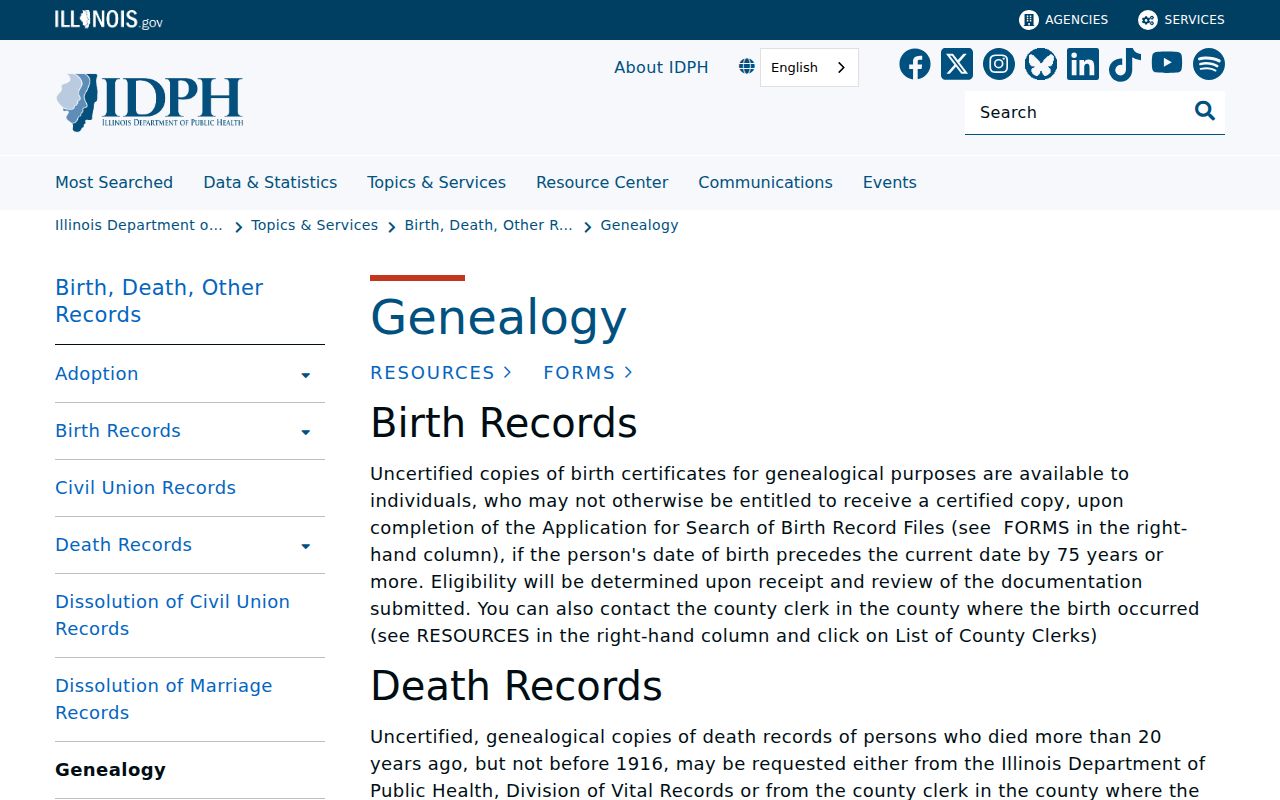
The state page helps route an eligible request, but event records must be ordered from the proper custodian. Marriage certificates generally come from the county clerk where the event occurred, while dissolution files come from the circuit clerk where granted.
Mount Prospect Boundaries Shift the Trail
Some southern areas developed under county rules and were annexed in the 1970s and 1980s. The Village parcel layer includes an annexation-year field, plus township, quarter-section, subdivision, zoning, district, and service data. A modern Mount Prospect address can therefore have older county or township records without an early Village file. That is a custodian change, not a gap in the property's life.
Old legal descriptions can outlast street numbering and postal labels. Compare plats, subdivision names, lot and block, parcel geometry, and former address forms before deciding the chain breaks. County historic imagery can also help: CookViewer upgrades added imagery back to 1998, full condo PIN support, nearby search, and printable reports. Date every screenshot because fields and controls change.
Note: Multiple parcel hits at one address require checking units, PINs, legal descriptions, and parcel shapes before following any name.
Document Mount Prospect Previous Residents
Finish with an evidence note for each person or household. Record the source, date, role, exact address or legal description, record number, and a second confirmation. Label the role plainly: occupant, subscriber, taxpayer, grantor, grantee, permit applicant, obituary subject, or census household member. That wording prevents a weak clue from becoming a false claim of residence.
Previous residents research is suitable for family history, a home's story, estate work, and personal curiosity. Limit the output to what is needed, especially when a record names living people. Do not use address history to track, intimidate, or harass anyone.
Lawful use. Historical records can contain errors and sensitive details; verify them with the custodian and respect protected information.